


Habitat & Wildlife Protection

Mount Kenya is home to some of Africa’s most iconic and endangered species: elephant, leopard, mountain bongo and over 80 endemic plant species found nowhere else on Earth. MKT’s wildlife protection work keeps this biodiversity intact through dedicated ranger teams, East Africa’s first wildlife corridor, human-wildlife conflict mitigation and active support for species recovery programmes.

Mount Kenya is increasingly surrounded by intensive agriculture, expanding settlements and infrastructure development, making its forests an ecological island in a sea of human activity. As habitat fragments, wildlife populations become isolated, genetic diversity declines, human-wildlife conflict intensifies and poaching pressure grows. Without active, sustained protection, the gains made through forest restoration can quickly be undone.

MKT’s wildlife protection model rests on three pillars: maintaining a strong, technology-enabled ranger presence across the ecosystem; reducing human-wildlife conflict through physical infrastructure and community engagement; and supporting the recovery of critically endangered species through partnerships with KWS, KFS and specialist conservation organisations. All three are essential. All three are interconnected.

Joint Wildlife Patrol Team
Formed at Ruthumbi in 2008, the JWPT combines MKT community guards with KWS Rangers a model of joint enforcement that has proven consistently effective in curtailing illegal activities on the northern sector of the mountain.

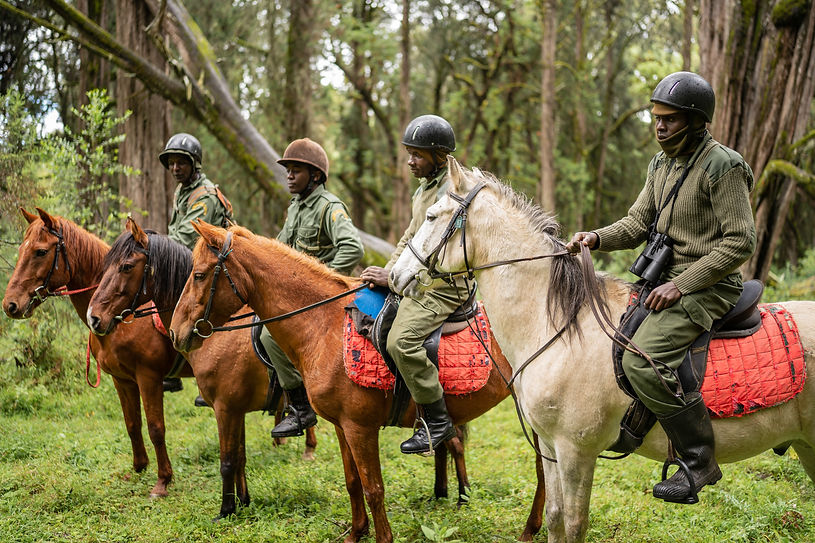
Horse Patrol Team
The Horseback Patrol Team covers vast distances on hardy Ethiopian ponies to monitor the forests and moorlands, with high altitude satellite camps extending their reach.
Imenti Patrol Team
Imenti Patrol Team tackles threats to the Imenti Forest Reserve, a once-neglected area that has been heavily logged and grazed, which we are now replanting with indigenous trees.
Marania Wildife Guards
Our Marania Guards were set up 20 years ago as a team of ex-poachers, working closely with the Kenya Wildlife Service for multi-day camping patrols to combat poaching.
Ranger Teams Operate Across Four Main Domains
Forest
Monitoring forest health · Anti-logging interventions · Wildfire fighting and fire break maintenance · Assisting active restoration planting and maintenance.
Wildlife
Wildlife monitoring and biodiversity surveys · Anti-poaching interventions · Bushmeat hunting prevention · Wildlife rescues and injured animal response.
Human Wildlife Conflict Management
Elephant corridor monitoring and management · Human-wildlife conflict monitoring across the boundary · Rapid HWC response · Community education on coexistence.
Riparian Protection
Riparian patrols along the Timau, Ontulili, Ngusishi and Teleswani rivers · Assisting riparian restoration planting · River clean-ups and waste removal · Water conservation education.

Non-Commissioned Corporals

Sergeant Darlington Mugisha
Overall Head

Corporal Charles Nyaga
Head Of The Marania Wildlife Guards

Corporal Martin Kinyua
Head Of The Joint Wildlife Protection Team

Corporal Gabriel Mithika Head Of The Imenti Patrol Team

Corporal Robert Murega
Head Of Fencers

Corporal Daniel Gitonga
Head Of The Horse Patrol Team